Services
Treatment of the entire spectrum of neurosurgical disorders with a special focus on minimally invasive therapy (MIC), spinal surgery, pain management procedures and many other neurosurgical procedures.
Spinal surgery
If pressure from the intervertebral discs or bony parts on the nerve roots or spinal cord leads to progressive or severe neurological deficits such as paralysis, numbness or bladder dysfunction, surgical relief is necessary. This can significantly improve quality of life.
Open surgical removal of herniated discs under the microscope
Microsurgical removal of herniated discs – under endoscopic control and with intraoperative nerve-muscle measurement if necessary – is always indicated when the pressure of the disc tissue on the nerve root or spinal cord causes severe neurological deficits such as paralysis, numbness or bladder emptying disorders.
The microsurgical procedure is usually performed under general anaesthesia and requires a one- to three-day hospital stay.
In the initial phase after the operation, it is important to rest the treated segment for up to six weeks.
If you wish, I can make the text even more patient-oriented or slightly more concise, depending on how your other service descriptions are structured.
Endoscopic removal of herniated discs (keyhole surgery)
Removing a herniated disc via a small incision (percutaneously/endoscopically) protects the surrounding tissue and usually shortens the post-operative recovery period.
During endoscopic removal of the herniated disc (discectomy), the neurosurgeon inserts thin special instruments with high-precision endoscopes and cameras under local anaesthesia – with an anaesthetist present if necessary – and guides them precisely to the disc space. There, the herniated disc tissue is gently removed with fine instruments. In addition, targeted thermal treatment of pain fibres in the area of the intervertebral disc ring can be performed.
If no tissue is removed during this procedure, but only the spinal cord sac and nerve roots are freed from adhesions, this is referred to as neurolysis. The procedure is usually performed on an outpatient basis or in a day clinic.
Reconstruction or artificial replacement of the intervertebral disc
In cases of progressive disc degeneration, it is possible to replace the disc surgically with a prosthesis or to rebuild it by means of an autologous disc cell transplant into the intervertebral space of the spine.
Bony enlargement of the spinal canal and/or nerve exit hole
Severe wear and tear of the spine often leads to bony narrowing of the spinal canal and nerve exit holes. Affected patients complain of stress-related back pain and a feeling of heaviness in the legs that occurs after walking a short distance (100–200 m). These symptoms necessitate extended “interlaminar fenestration”; this involves removing bony parts of the vertebral arch (lamina) under general anaesthesia and widening the nerve exit hole in order to relieve pressure on the nerve tissue and improve its blood supply.
Surgical stabilisation of the spine
In the course of the natural ageing process, due to constant incorrect loading or surgical interventions, ligaments can occasionally weaken, leading to hypermobility of individual spinal segments (spondylolisthesis). If the instability cannot be eliminated through targeted muscle training, surgical stabilisation is indicated.
This involves implanting bone-filled baskets into the intervertebral disc space and additionally stabilising the vertebral bodies with a dynamic titanium scaffold (internal fixator). This modern “stiffening” procedure is performed under general anaesthesia and requires a hospital stay of approximately 10–14 days with appropriate follow-up physiotherapy.
Open surgical removal of herniated discs under the microscope
Microsurgical removal of herniated discs – under endoscopic control and with intraoperative nerve-muscle measurement if necessary – is always indicated when the pressure of the disc tissue on the nerve root or spinal cord causes severe neurological deficits such as paralysis, numbness or bladder emptying disorders.
The microsurgical procedure is usually performed under general anaesthesia and requires a one- to three-day hospital stay.
In the initial phase after the operation, it is important to rest the treated segment for up to six weeks.
If you wish, I can make the text even more patient-oriented or slightly more concise, depending on how your other service descriptions are structured.
Endoscopic removal of herniated discs (keyhole surgery)
Removing a herniated disc via a small incision (percutaneously/endoscopically) protects the surrounding tissue and usually shortens the post-operative recovery period.
During endoscopic removal of the herniated disc (discectomy), the neurosurgeon inserts thin special instruments with high-precision endoscopes and cameras under local anaesthesia – with an anaesthetist present if necessary – and guides them precisely to the disc space. There, the herniated disc tissue is gently removed with fine instruments. In addition, targeted thermal treatment of pain fibres in the area of the intervertebral disc ring can be performed.
If no tissue is removed during this procedure, but only the spinal cord sac and nerve roots are freed from adhesions, this is referred to as neurolysis. The procedure is usually performed on an outpatient basis or in a day clinic.
Reconstruction or artificial replacement of the intervertebral disc
In cases of progressive disc degeneration, it is possible to replace the disc surgically with a prosthesis or to rebuild it by means of an autologous disc cell transplant into the intervertebral space of the spine.
Bony enlargement of the spinal canal and/or nerve exit hole
Severe wear and tear of the spine often leads to bony narrowing of the spinal canal and nerve exit holes. Affected patients complain of stress-related back pain and a feeling of heaviness in the legs that occurs after walking a short distance (100–200 m). These symptoms necessitate extended “interlaminar fenestration”; this involves removing bony parts of the vertebral arch (lamina) under general anaesthesia and widening the nerve exit hole in order to relieve pressure on the nerve tissue and improve its blood supply.
Surgical stabilisation of the spine
In the course of the natural ageing process, due to constant incorrect loading or surgical interventions, ligaments can occasionally weaken, leading to hypermobility of individual spinal segments (spondylolisthesis). If the instability cannot be eliminated through targeted muscle training, surgical stabilisation is indicated.
This involves implanting bone-filled baskets into the intervertebral disc space and additionally stabilising the vertebral bodies with a dynamic titanium scaffold (internal fixator). This modern “stiffening” procedure is performed under general anaesthesia and requires a hospital stay of approximately 10–14 days with appropriate follow-up physiotherapy.
Vertebral body straightening (vertebroplasty or kyphoplasty)
Severe back pain is often the result of a vertebral body fracture. Pre-damaged bones can fracture even from minor causes. This is particularly common in people with severe osteoporosis.
Spinal realignment is a modern method for stabilising the spine that requires only a short hospital stay. The procedure is usually performed under local anaesthetic.
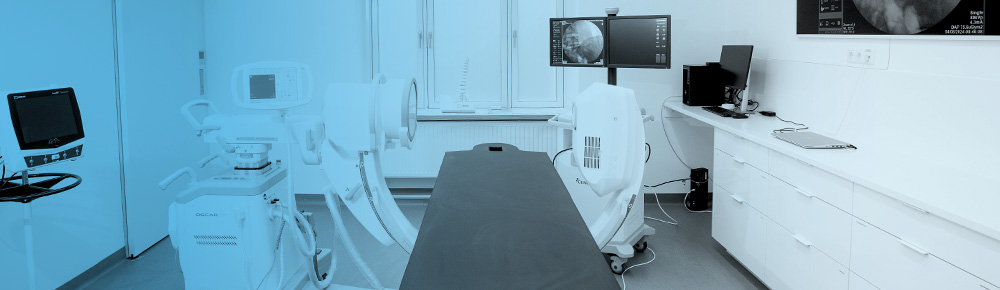
During the operation, the affected vertebrae are accessed from the back under continuous X-ray or CT monitoring to prevent the extremely rare occurrence of cement being carried into the blood vessels or spinal canal. After placing a thin sleeve, sterile bone cement is injected. This cement is essentially the same as that used for decades to cement joint prostheses.
Other surgical procedures
Microsurgical removal of tumours and cysts in the area of the spinal cord or spine.
Vertebral body straightening (vertebroplasty or kyphoplasty)
Severe back pain is often the result of a vertebral body fracture. Pre-damaged bones can fracture even from minor causes. This is particularly common in people with severe osteoporosis.
Spinal realignment is a modern method for stabilising the spine that requires only a short hospital stay. The procedure is usually performed under local anaesthetic.
During the operation, the affected vertebrae are accessed from the back under continuous X-ray or CT monitoring to prevent the extremely rare occurrence of cement being carried into the blood vessels or spinal canal. After placing a thin sleeve, sterile bone cement is injected. This cement is essentially the same as that used for decades to cement joint prostheses.
Other surgical procedures
Microsurgical removal of tumours and cysts in the area of the spinal cord or spine.